
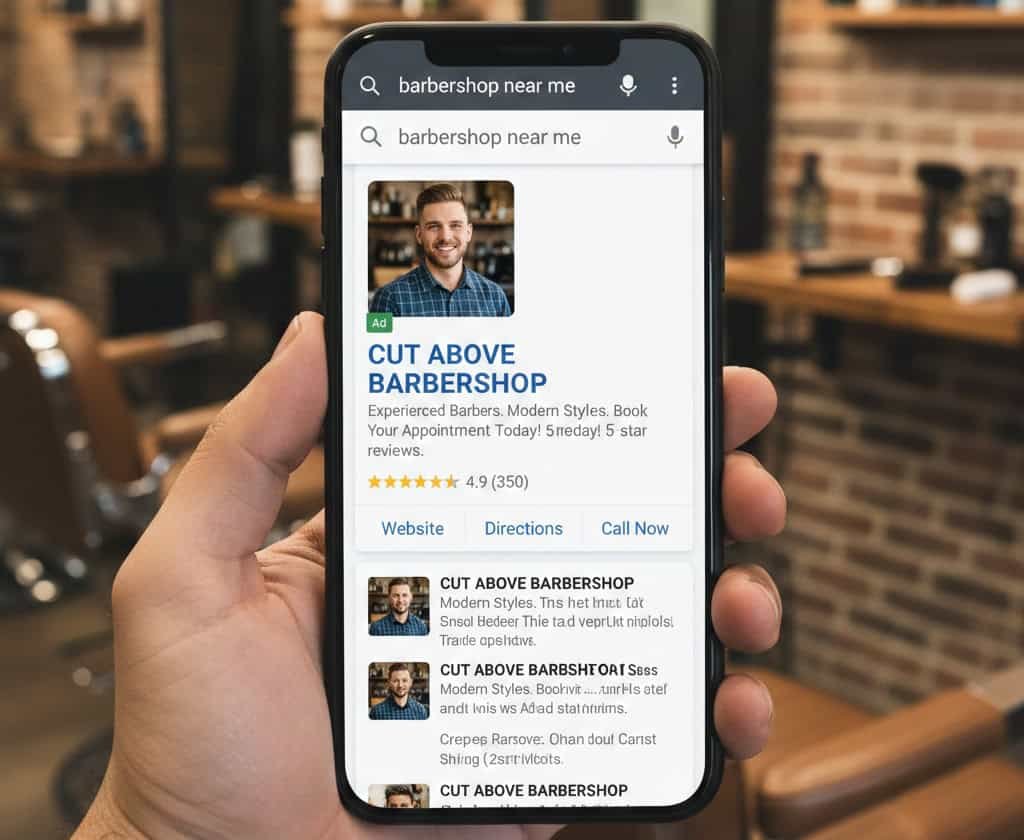
Looking for Google Ads for barbershop?
Even the sharpest fades and cleanest shaves need more than word of mouth to stand out. Barbershops surely do thrive on community, style, and trust. However, you still need sufficient visibility to keep chairs filled and clippers buzzing.
That’s where Google Ads can change the game. Imagine a potential client searching “best barbershop near me”. The right ad strategy will put your barbershop as the first name on the search results.
Google Ads does more than putting your shop on the map; it helps you target the exact people most likely to book an appointment. They may look for a quick trim, a stylish beard shape-up, or even a full grooming experience.
Google Ads Basics for Barbershops
Google Ads is Google’s proprietary online advertising platform where businesses bid on keywords so their ads appear when users search relevant terms. Ads are shown based on a real-time auction system.
Advertisers set bids, Google evaluates ad quality, and the best combination wins placement. When someone searches “barber near me”, your shop can appear at the top when they’re ready to book.
Different Types of Google Ads
- Search Ads: Text ads triggered by keywords like “men’s haircut [city]”. Customers are actively looking for a haircut.
- Local Services Ads: Pay-per-lead ads (available in select regions) that show verified local businesses. Builds trust with “Google Guaranteed” badge; ideal for local walk-ins.
- Display & Remarketing Ads: Visual banner ads across Google’s partner sites. Keeps your shop top-of-mind, promotes offers, and re-engages past clients.
How Does Pay-Per-Click (PPC) Pricing Work?
- PPC Model: You only pay when someone clicks your ad.
- Average CPC (Cost Per Click): Globally, CPC ranges from $4.51 – $5.26, depending on industry. Local service industries like barbershops often pay less than the finance or legal sectors.
- Budgeting: Most small businesses spend between $100 – $10,000 per month on Google Ads.
- Auction Factors: CPC depends on keyword competition, location, and ad quality score. A well-optimized ad can lower costs while improving visibility.
Common Barbershop Advertising Goals
- Increase Walk-ins: Target local keywords (“barbershop open now”) and use Local Services Ads to capture nearby customers.
- Drive Appointment Bookings: Use Search Ads with extensions like “Book Now” linked to scheduling software.
- Promote Special Offers: Display Ads and remarketing are perfect for showcasing discounts (“20% off beard trims this week”).
Choosing the Right Goal for Campaign Setup
- If your shop struggles with visibility, choose the Walk-ins goal.
- If you want predictable scheduling, stick to the Appointment bookings goal.
- If you’re running seasonal promotions, set the Special Offers goal.
Keyword Research for Barbershop Google Ads
Finding and implementing the right keywords is mandatory for a profitable campaign. You must show up when local customers are actively searching and match your targeting to clear business goals.
High-Intent Local Keywords
These capture customers who are ready to buy, often within hours. Build tightly themed ad groups around specific intents and locations.
- Near-Me Intent: “barbershop near me”, “barber near me”, “fade haircut near me”, “beard trim near me”.
- City + Service Intent: “men’s haircut [city]”, “best barber [city]”, “kids haircut [city]”, “beard shaping [city]”.
- Appointment Intent: “book barber [city]”, “same day haircut [city]”, “walk-in barbershop [city]”.
- Style-Specific Intent: “skin fade barber [city]”, “pompadour haircut [city]”, “taper fade [city]”.
- Geo-Modifiers and Micro-Areas: Neighborhoods, landmarks, and radii (“barber [area]”, “haircuts near [area]”).
Branded vs Non-Branded Keywords
Balance discovery (new customers) with defense (owning your brand presence).
- Branded Keywords: “[Your barbershop name]”, “[Your brand] barber”, misspellings, and variations. They capture high-intent, existing demand and defend against competitors. Use lower bids and exact/phrase match to keep costs down. Add sitelinks (Book, Services, Pricing).
- Non-Branded Keywords: “barbershop near me”, “men’s haircut [city]”, “best barber [city]”. Discover new customers; higher volume but more competition. Structure ad groups by service and intent; tailor ad copy and landing pages to each theme for better conversion rates.
- Hybrid Branded-Intent: “[Your brand] + service” (“[name] Barbers men’s haircut”). Ensure you own navigational + transactional queries when customers compare your specific service pages.
Negative Keywords to Avoid Wasted Spend
Negative keywords block irrelevant searches so your budget focuses on buyers.
- Category Blocker Example: “free”, “DIY”, “at home”, “how to”, “tutorial”, “school”, “course”, “jobs”, “wholesale”, “equipment”, “product”, “wig”, “salon” (if you don’t offer unisex services). They prevent clicks from people seeking information, training, employment, or products.
- Price and Offer Mismatch Example: “cheap”, “low-cost”, “discount code” if your positioning is premium. Align negatives with your brand’s pricing tier to avoid mismatch traffic.
- Service Exclusion Example: “women’s haircut” (if male-only), “hair color”, “spa” (if not offered). They can keep your ads relevant and improve conversion rates.
- Geography Exclusion Example: Cities/areas you don’t serve; language terms if you operate in one language. Use both campaign-level negative lists and shared negative lists for consistent control.
- Discovery Process: Review the Search Terms report weekly, add irrelevant queries as negatives, and maintain shared negative lists across campaigns. Start broad, then refine.
Keyword Match Types and Impact
Use match types strategically to balance reach with control.
- Exact Match Format: barbershop near me. Highest relevance, cleaner intent, predictable CPC; ideal for core money keywords. Lower volume; requires robust list building.
- Phrase Match Format: “men’s haircut”. Captures queries containing your phrase in order, including modifiers like “near me” or “[city]”; good balance of scale and precision. Inclusion of semi-related variations – monitor search terms.
- Broad Match Format: barber. Maximum reach; surfaces new queries and long-tail terms; can lower CPA with strong signals (smart bidding + high-quality landing pages). Risk of irrelevant traffic; requires tight negatives, location targeting, and value-based bidding.
Start with exact + phrase for core services and near-me queries. Layer broad in separate testing ad groups with conservative budgets and strict negatives.
Use smart bidding (Maximize Conversions/Target CPA) once you have 30–50 conversions to help broad match find qualified traffic. Continuously prune via Search Terms to tighten relevance.
Expert Recommendations Based on Real-Time Examples
Intent Segmentation
Create separate ad groups for “near me”, “book now”, and “specific styles” to tailor ad copy and extensions. It should improve click-through rate and Quality Score.
Ad Relevance Lowers Cost
When your keyword, ad copy, and landing page tightly match, you often pay less per click due to higher expected performance. Use dedicated landing pages for “men’s haircut” vs. “beard trim”.
Use Location Signals Aggressively
Combine city, neighborhood, and “near me” terms with a 3–5 km radius and location extensions. Show hours, distance, reviews, and a map pin.
Schedule for Demand Peaks
Bid more during peak grooming times (Thursday – Saturday, late afternoons). Use ad scheduling and sitelinks like “Walk-ins Welcome” during busy hours.
Leverage Extensions
Call extension for instant calls during open hours. Location extension pulls in Google Business Profile credibility. Promotion extension like “20% off beard trims this week”. Structured snippets like “Skin fade, Beard trim, Hot towel shave”.
How to Create High-Converting Ad Copy?
Great ad copy for barbershops is specific, local, and action-focused. It highlights the service, the neighborhood, and the reason to act now, then makes it effortless to book or call.
Writing Compelling Headlines
Pair your core service with a neighborhood or city to match local search intent and boost relevance. Headlines that include the user’s intent and geographic context earn more qualified clicks because they mirror the query and reduce mental friction.
Use Numbers and Proof Points
Concrete claims feel trustworthy and scannable. Test numbers (ratings, years in business, cut duration) in Headline 1 vs Headline 2 to find what lifts CTR without crowding keywords.
Keep Headlines Tight and Keyword-Aligned
Character limits demand clarity. Front-load the most critical keyword (“Men’s Haircut”) and follow with the differentiator (“Same-Day”, “Near Me”, “Open Now”). Build separate ad groups per service (men’s haircut, beard trim, skin fade) and neighborhood.
Implement Urgency and Offers
Create Time-Based Urgency: Immediate availability is a powerful motivator. Example: “Same-Day Cuts – Limited Slots”, “Walk-Ins Until 8 PM”, “Last-Minute Appointments Available”.
Feature Clear Value Offers: Simple, specific promotions outperform vague discounts. Example: “20% Off First Visit”, “$10 Off Beard Trim This Week”, “Student Pricing Mon – Thu”.
Align Urgency with Hours and Staffing: Increase bids and show urgency during peak windows (Thu – Sat, late afternoons). Pair messaging with availability to prevent disappointment and wasted clicks.
Landing Pages to Turn Clicks into Bookings
Clear Service Offer
- Above-the-Fold Clarity: A focused headline with location + service (“Men’s Haircut & Skin Fades in [area] – Same-Day Available”).
- One Dominant CTA: “Book Now” or “Call Today” as a primary button, visible without scrolling. Clear CTAs paired with strategic placement drive action.
- Proof, Fast: Star ratings, recent Google reviews, before/after gallery, “X+ years in business,” stylist bios. Social proof reduces perceived risk and boosts credibility.
Mobile-First Design for Quick Bookings
- Design for Thumbs: Large tap targets, sticky “Book” and “Call” bars, short forms (name + phone + time), and instant map/directions.
- Content Hierarchy: Hero (service + location + CTA) → trust proof (reviews) → services grid → gallery → FAQs → secondary CTA.
- Speed is Conversion: Optimize images (WebP), lazy-load galleries, compress CSS/JS, and avoid heavy sliders.
- Keep It Simple: Minimal navigation (or none), scannable copy, consistent offer messaging, and limited form fields.
Landing Page Checklist for Barbershops
- Hero Section: Service + location and hours aligned to ad copy. Book Now or Call Today as primary CTA (sticky on mobile).
- Trust Cluster: Reviews (star rating + latest quotes), proof (years in business, stylist bios, hygiene practices).
- Service Grid: Labels like Men’s haircut, skin fade, beard trim, hot towel shave. Transparent pricing (range to set expectations).
- Gallery: Optimized in WebP, lazy-load; recognizable styles. Location extension integration for map pin, directions link.
Budgeting and Bidding Strategies for Barbershops
Running Google Ads for a barbershop is limited to writing great ad copy. You must manage your money wisely simultaneously. A well-structured budget bidding ensures you attract the right clients without draining your wallet.
Start Small, Scale Smart
For local service businesses like barbershops, a daily budget of $10 – $30 is sufficient to test campaigns. It translates to $300 – $900 per month.
In dense urban areas (New York, London), higher competition may require spending $40-$60 per day to stay visible. Lower CPCs mean you can achieve results with smaller budgets in emerging markets.
Budget Allocation: 60% for core services (men’s haircut, beard trim), 25% for promotions (discounts, seasonal offers), and 15% for brand defense (ads on your shop’s name).
Cost-Per-Click (CPC) Expectations for Local Services
Local service industries (barbers, plumbers, salons) usually see CPCs of $2-$6 in the US. In South Asia, CPCs can range from $0.20 to $1.50, depending on competition. High-intent keywords cost more –
- “Barbershop near me” → higher CPC due to strong commercial intent.
- “Men’s haircut [city]” → moderate CPC, but highly relevant.
- “Fade haircut tutorial” → low CPC, but irrelevant (should be excluded with negative keywords).
Ads with relevant keywords, substantial CTR, and optimized landing pages can reduce CPC by up to 30%, meaning you pay less for better placement. Focus on “near me” and city-specific keywords.
Manual vs Automated Bidding Strategies
- Manual CPC: You set max CPC for each keyword. Best for beginners testing keywords with tight control.
- Enhanced CPC (ECPC): Google adjusts bids slightly based on the likelihood of conversion. Good middle ground, let Google optimize while keeping control.
- Target CPA (Cost Per Acquisition): Automated bidding to achieve a set cost per booking. Works well once you have 30–50 conversions to train the algorithm.
- Maximize Conversions: Google spends its budget to get the most bookings possible. Ideal for shops with consistent demand and flexible budgets.
- Target ROAS (Return on Ad Spend): Focuses on revenue vs spend. More advanced; applicable if you track revenue per service.
The sharpest fades or the cleanest shaves alone can’t bring success to the modern grooming industry. You must remain seen at the right time, in the right place. And Google Ads gives barbershops the power to put services directly in front of customers who are actively searching.
Contact Ruban KT a Google ads specialist for Google Ads for barbershop.
Frequently Asked Questions
Most local barbershops can start with $10-$30 per day. Such a budget is enough to test keywords and generate leads. Scale up once you see consistent ROI.
Focus on high-intent local keywords such as “barbershop near me”, “men’s haircut [city]”, “fade haircut near me”. They should capture customers ready to book immediately.
Negative keywords block irrelevant searches like “barber jobs”, “DIY haircut”, or “cheap wigs”. It can prevent wasted clicks and ensure your ads only reach potential customers.
Search Ads are the best for immediate bookings. Local Services Ads (LSAs) are pay-per-lead ads with Google’s “Guaranteed” badge. Display & Remarketing Ads are great for promoting offers.
Targeting too wide an area (wasted spend), using generic keywords (low intent), poor mobile UX (lost conversions), not tracking calls/bookings (no ROI data), and ignoring negative keywords (budget drain).

I am an digital marketing specialist who is expert in SEO & Google ads.